 ≡
≡translate this: 1. Sequências e sucessões
1. Sequences and series (sequences)
A sequence (or succession) is an ordered list of numbers that follow a pattern.
Each number in the sequence is called a term.
📌 Example of a sequence:
\( 2, 4, 6, 8, 10, \dots \)
✔ Here, the numbers increase by 2 em 2.
👉 We can represent the terms using indices:
\( a_1, a_2, a_3, a_4, \dots \)
Where:
\( a_1 \) = first term
\( a_2 \) = second term
And so on.
2. Sequence on the Cartesian plane
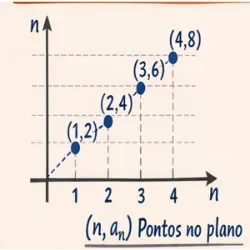
A sequence can be represented on a Cartesian graph.
Each term is associated with a point in the plane:
\( (n, a_n) \)
📌 Example:
Sequence: \( 2, 4, 6, 8 \)
Points on the graph:
\( (1,2), (2,4), (3,6), (4,8) \)
✔ On the graph:
The horizontal axis represents the position \( n \)
The vertical axis represents the value \( a_n \)
3. Arithmetic sequence
An arithmetic sequence (AP) is a sequence in which the difference between consecutive terms is constant.
📌 This difference is called the common difference \( r \)
👉 Formula for the common difference:
\( r = a_{n+1} - a_n \)
📌 Example:
Sequence: \( 3, 7, 11, 15 \)
Differences:
\( 7 - 3 = 4, \quad 11 - 7 = 4 \)
✔ Common difference: \( r = 4 \)
4. General term of an arithmetic sequence
The general term allows us to find any term in the sequence.
📌 Formula:
\( a_n = a_1 + (n - 1) \cdot r \)
Where:
\( a_n \) = the term we want to find
\( a_1 \) = first term
\( r \) = common difference
\( n \) = position of the term
📌 position of the term
:
Sequence: \( 5, 8, 11, 14, \dots \)
We have:
\( a_1 = 5, \quad r = 3 \)
Find the 4th term:
\( a_4 = 5 + (4 - 1) \cdot 3 \)
\( a_4 = 5 + 9 = 14 \)
✔ Result: \( a_4 = 14 \)
5. Important interpretation
✔ Sequences can be increasing or decreasing
✔ Arithmetic sequences have a constant difference
✔ The graph of an arithmetic sequence forms aligned points (a straight line)
✔ The general term allows you to calculate any term without listing all terms
Did you know?