 ≡
≡
quiz
Mathematics EN 9th gradeProve your knowledge in the Arena
Are you prepared for the 9th grade National Mathematics Exam?
Fractions, equations, statistics, and geometry... they seem easy, but can you answer the questions correctly? Test your knowledge and find out if you're ready for the exam!
Why test your knowledge?
Testing your knowledge improves memory, quick thinking, and the ability to make associations, as well as being a fun way to learn while competing with other people.
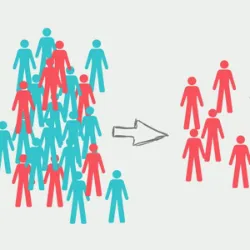
What is Statistics?
Statistics studies the collection, organization, analysis, and interpretation of data.
👉 It is used to draw conclusions about a set of information.
1. STATISTICAL POPULATION.
Definition:
The statistical population is the set of all elements we want to study.
📌 It may include:
People;
Objects;
Animals;
Data.
📌 Examples:
All students in a school.
All inhabitants of a city.
All items produced in a factory.
📌 Example:
If we want to study the height of students in a class, the population is all the students in that class.
👉 It represents the “whole” of the study.
2. SAMPLE
Definition:
A sample is a subset of the population.
👉 It is a representative part of the population used when it is not possible to study all elements.
📌 Example:
If a school has 500 students, we may study only 50 students.
👉 Those 50 students form a sample.
CALCULATIONS IN POPULATION AND SAMPLE
1. Basic counts
📌 Example:
Population: 28 students.
Sample: 7 students.
2. Relative frequency
\( \text{frequência relativa} = \frac{\text{frequência absoluta}}{\text{total de dados}} \)
📌 Example:
\( \frac{5}{20} = 0{,}25 = 25\% \)
3. Percentage
percentage = relative frequency × 100
📌 Example:
\( 0{,}4 \times 100 = 40\% \)
4. Proportion (estimate)
📌 Example:
If 30% of the sample prefers something → we estimate about 30% in the population.
5. Mean
\( \text{média} = \frac{\text{soma dos valores}}{\text{número de valores}} \)
📌 Example:
\( \frac{10 + 12 + 14}{3} = 12 \)

What are rational numbers?
They are numbers that can be written in fraction form:
\( \frac{a}{b}, \quad b \neq 0 \)
Examples:
\( \frac{3}{4}, -2, 0{,}5, -\frac{7}{3} \)
valor absoluto
The valor absoluto represents the distance to zero:
\( |a| = a \) se \( a \geq 0 \)
\( |a| = -a \) se \( a < 0 \)
Examples:
\( |5| = 5 \)
\( |-5| = 5 \)
Simétrico
The Simétrico of a number is:
\( -a \)
Examples:
\( 3 \rightarrow -3 \)
\( -7 \rightarrow 7 \)
Adição e subtração
Addition with the same sign
Add the values and keep the sign
Examples:
\( 3 + 5 = 8 \)
\( -4 + (-6) = -10 \)
Soma com sinais contrários
Subtract the values and take the sign of the number with the greatest absolute valueNL# Examples:
\( 7 + (-3) = 4 \)
\( -8 + 5 = -3 \)
Soma de números simétricos
The result is always zero
\( a + (-a) = 0 \)
Examples:
\( 5 + (-5) = 0 \)
Subtração (diferença)
It is transformed into the sum of the opposite
\( a - b = a + (-b) \)
Examples:
\( 7 - 3 = 7 + (-3) = 4 \)
\( 5 - (-2) = 5 + 2 = 7 \)
Divisão de números racionais
Main rule
Multiply by the reciprocal
\( \frac{a}{b} \div \frac{c}{d} = \frac{a}{b} \times \frac{d}{c} \) Inverso de um número racional
Swap the numerator and denominator
\( \text{Inverso de } \frac{a}{b} = \frac{b}{a}, \quad a \neq 0 \)
Examples:
\( \frac{3}{4} \rightarrow \frac{4}{3} \)
\( 2 = \frac{2}{1} \rightarrow \frac{1}{2} \)
Important:
\( 0 \text{ não tem inverso} \)
Examples de divisão
\( \frac{2}{3} \div \frac{4}{5} = \frac{2}{3} \times \frac{5}{4} = \frac{10}{12} = \frac{5}{6} \)
TIPS
✔ Same signs → add and keep the sign ✔ Different signs → subtract and take the sign of the number with the greatest absolute value ✔ Subtraction → convert to addition ✔ Division → multiply by the reciprocal ✔ Número + simétrico: \( a + (-a) = 0 \)
✔ Valor absoluto: \( |a| \geq 0 \)















Discover some interesting facts about Mathematics EN 9th grade
Real Numbers & Powers

1. Powers with integer exponents
- General rule:
\( a^n \) means multiplying 𝑎 by itself 𝑛 times
✔ Example:
\( 2^3 = 2 \times 2 \times 2 = 8 \)
- Zero exponent:
\( a^0 = 1 \), with \( a \neq 0 \)
✔ Example:
\( 5^0 = 1 \)
- Negative exponent:
\( a^{-n} = \frac{1}{a^n} \), with \( a \neq 0 \)
✔ Example:
\( 2^{-3} = \frac{1}{8} \)
- Rules important:
\( a^m \times a^n = a^{m+n} \)
\( \frac{a^m}{a^n} = a^{m-n} \)
\( (a^m)^n = a^{m \cdot n} \)
✔ Example:
\( 2^3 \times 2^2 = 2^5 = 32 \)
2. Scientific Notation
- Form:
\( a \times 10^n \), with \( 1 \leq a < 10 \)
✔ Examples
\( 3000 = 3 \times 10^3 \)
\( 0.004 = 4 \times 10^{-3} \)
3. Real Numbers and Decimals
- Real Numbers
Include: integers, rational and irrational numbers
- Decimals
✔ Finite decimal:
\( 0.5 = 1/2 \)
✔ Repeating decimal:
\( 0.333... = 1/3 \)
4. Operations with Real Numbers
- Order of operations:
Parentheses
Powers
Multiplication and division
Addition and subtraction
✔ Example:
\( 2 + 3 \times 4 = 2 + 12 = 14 \)
Order, Intervals and Approximations

1. Order Relations in 𝑅
- Symbols
\( > \), \( < \), \( \geq \), \( \leq \)
✔ Example:
\( -3 < 2 \)
2. Approximate Values:
- Rounding
✔ Example:
\( 3{,}46 \approx 3{,}5 \)
- Truncation
✔ Example:
\( 3{,}46 \approx 3{,}4 \)
3. Intervals of real numbers
- Types:
\( [a, b] \)\( [a, b] \) (includes endpoints)
\( ]\( ]a, b[ \)a, b[ \) (does not include endpoints)
✔ Examples:
\( [1, 3] \)
\( ]1, 3[ \)
4. Intersection of intervals:
👉 Common part
✔ Example:
\( [1, 5] \cap [3, 7] = [3, 5] \)
5. Interval Union
👉 Union of intervals
✔ Example:
\( [1, 3] \cup [2, 5] = [1, 5] \)
QUICK TIPS FOR THE EXAM
✔ Negative exponent → becomes a fraction
✔ Scientific notation → number between 1 and 10
✔ Order → pay attention to negative signs
✔ Intervals → brackets include, parentheses do not include
✔ Intersection → common part
✔ Union → everything together
Introduction to Polynomials

Monomials and Polynomials
- Monomials
Expression with a single term
\( 3x^2,\ -5x,\ 7 \)
- Polynomial
Sum of monomials
\( 3x^2 + 2x - 5 \)
2. Sum of polynomials
Like terms are added
✔ Example:
\( (2x + 3) + (x + 5) = 3x + 8 \)
3. Product of a monomial by a polynomial
Distribute the monomial
✔ Example:
\( 2x(3x + 4) = 6x^2 + 8x \)
4. Operations with polynomials
✔ Example:
\( (x + 2)(x + 3) = x^2 + 5x + 6 \)
5. Notable Cases
- Square of a binomial
\( (a + b)^2 = a^2 + 2ab + b^2 \)
✔ Exemplo:
\( (x + 2)^2 = x^2 + 4x + 4 \)
- Diferença de quadrados
\( a^2 - b^2 = (a - b)(a + b) \)
✔ Example:
\( x^2 - 9 = (x - 3)(x + 3) \)
6. Polynomial Factorization
- Distributive Property
\( ax + ay = a(x + y) \)
✔ Example:
\( 3x + 6 = 3(x + 2) \)
- Difference of Squares
\( x^2 - 16 = (x - 4)(x + 4) \)
- Binomial Square
✔ Example:
\( x^2 + 4x + 4 = (x + 2)^2 \)
First and second degree equations

1. First-degree equations
Form:
\( ax + b = 0 \)
✔ Example:
\( 2x + 4 = 0 \Rightarrow x = -2 \)
2. First-degree inequalities
✔ Example:
\( 2x + 1 > 5 \Rightarrow x > 2 \)
3. Quadratic Equations
- General Form
\( ax^2 + bx + c = 0 \), com \( a \neq 0 \)
- Zero-Product Law
\( ab = 0 \Rightarrow a = 0 \ \text{ou} \ b = 0 \)
- Incomplete Equations
✔ Example:
\( x^2 - 9 = 0 \Rightarrow x = \pm 3 \)
- Complete Equations
\( x = \frac{-b \pm \sqrt{b^2 - 4ac}}{2a} \)
✔ Example:
\( x^2 - 5x + 6 = 0 \Rightarrow x = 2 \ \text{ou} \ x = 3 \)
4. Literal Equations
Solving for a function of one variable
✔ Example:
\( ax + b = 0 \Rightarrow x = -\frac{b}{a} \)
5. Systems of Equations
✔ Example:
\(
\begin{cases}
x + y = 5 \\
x - y = 1
\end{cases}
\Rightarrow x = 3,\ y = 2
\)
- Classification:
Possible and determined system (one solution)
Impossible system (no solution)
Indeterminate system (infinite solutions)
QUICK TIPS FOR THE EXAM/b>
✔ Similar terms → same literal part
✔ Always distribute correctly
✔ Notable cases → memorize formulas
✔ Zero product → separate into two equations
✔ Always check the solutions
translate this: 1. Definição de função

1. Definition of a function
A function is a relation that associates each value of x with a unique value of y.
\( y = f(x) \)
👉 For each x, there is only one y.
✔ Example:
\( f(x) = 2x + 1 \)
If 𝑥 = 2, then
\( f(2) = 2 \cdot 2 + 1 = 5 \)
2. Domain of a function
It is the set of values of 𝑥 that can be used
\( D_f \)
✔ Example:
\( f(x) = \frac{1}{x} \Rightarrow x \neq 0 \)
👉 Domain: all real numbers except zero
3. Codomain (range set)
It is the set of all possible output values
\( \mathbb{R} \)
👉 Usually these are the real numbers
4. Image (values that the function assumes)
These are the values that actually appear as a result
✔ Example:
\( f(x) = x^2 \)
👉 The image consists only of positive values or zero
5. Independent and dependent variables
- Independent variable → chosen value
\( x \)
- Dependent variable → depends on x
\( y = f(x) \)
✔ Example:
\( y = 3x \)
👉 If x changes, y changes
6. Graphical Representation
It is the graph of the function on the Cartesian plane. Each point has the form:
\( (x, f(x)) \)
✔ Example:
\( f(x) = x + 1 \)
Points on the graph:
\( (0,1), (1,2), (2,3) \)
👉 Forms a straight line
QUICK TIPS FOR THE EXAM
✔ Function → each x has a unique y
✔ Domain → possible values of x
✔ Range → obtained values
✔ Graph → points (x, f(x))
✔ x independent, y dependent
HOME