 ≡
≡translate this: O que é Estatística?
What is Statistics?
Statistics studies the collection, organization, analysis, and interpretation of data.
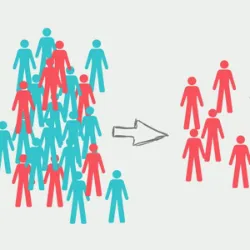
👉 It is used to draw conclusions about a set of information.
1. STATISTICAL POPULATION.
Definition:
The statistical population is the set of all elements we want to study.
📌 It may include:
People;
Objects;
Animals;
Data.
📌 Examples:
All students in a school.
All inhabitants of a city.
All items produced in a factory.
📌 Example:
If we want to study the height of students in a class, the population is all the students in that class.
👉 It represents the “whole” of the study.
2. SAMPLE
Definition:
A sample is a subset of the population.
👉 It is a representative part of the population used when it is not possible to study all elements.
📌 Example:
If a school has 500 students, we may study only 50 students.
👉 Those 50 students form a sample.
CALCULATIONS IN POPULATION AND SAMPLE
1. Basic counts
📌 Example:
Population: 28 students.
Sample: 7 students.
2. Relative frequency
\( \text{frequência relativa} = \frac{\text{frequência absoluta}}{\text{total de dados}} \)
📌 Example:
\( \frac{5}{20} = 0{,}25 = 25\% \)
3. Percentage
percentage = relative frequency × 100
📌 Example:
\( 0{,}4 \times 100 = 40\% \)
4. Proportion (estimate)
📌 Example:
If 30% of the sample prefers something → we estimate about 30% in the population.
5. Mean
\( \text{média} = \frac{\text{soma dos valores}}{\text{número de valores}} \)
📌 Example:
\( \frac{10 + 12 + 14}{3} = 12 \)