 ≡
≡The Pythagorean Theorem
The Pythagorean Theorem applies only to right triangles.
If a triangle has legs \( a \) and \( b \) and hypotenuse \( c \), then:
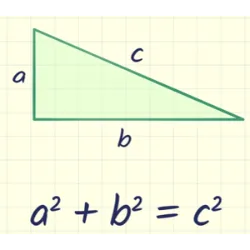
\( c^2 = a^2 + b^2 \)
✔ Where:
\( c \) = hypotenuse (longest side)
\( a, b \) = legs
Example 1
\( a = 3 \) and \( b = 4 \)
\( c^2 = 3^2 + 4^2 \)
\( c^2 = 9 + 16 \)
\( c^2 = 25 \)
\( c = \sqrt{25} = 5 \)
✔ Result: \( c = 5 \)
Example 2
\( c = 13 \) and \( a = 5 \)
\( 13^2 = 5^2 + b^2 \)
\( 169 = 25 + b^2 \)
\( b^2 = 144 \)
\( b = \sqrt{144} = 12 \)
✔ Result: \( b = 12 \)
2. Converse of the Pythagorean Theorem
If, in a triangle, the sides satisfy:
\( c^2 = a^2 + b^2 \)
then the triangle is a right triangle.
Example 3
Sides: \( 6, 8, 10 \)
\( 10^2 = 6^2 + 8^2 \)
\( 100 = 36 + 64 \)
\( 100 = 100 \)
✔ Conclusion: right triangle
3. Important notes
✔ The hypotenuse is always the longest side
✔ The theorem is used to calculate lengths
✔ The converse is used to verify right triangles
Distance in the plane:
\( d = \sqrt{(x_2 - x_1)^2 + (y_2 - y_1)^2} \)
4. Key points for the exam
✔ Identify the hypotenuse correctly
✔ Apply \( c^2 = a^2 + b^2 \)
✔ Solve equations with powers and roots
✔ Use the converse to justify answers