 ≡
≡Geometric Loci
What is a geometric locus?
A geometric locus is the set of all points that satisfy a given condition.
In simple terms:
It is the set of points that obey a specific rule.
Example: The points that are at a fixed distance from a point form a circle.
1. Geometric loci in the plane
Main idea: In the plane, a geometric locus can be:
A line
A circle
A region of the plane
Examples: Points at a fixed distance from a point → circle
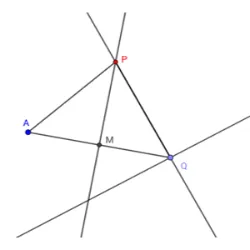
Points equidistant from two points → perpendicular bisector
2. Perpendicular Bisector
- Definition
The perpendicular bisector of a segment is the line that:
Passes through the midpoint of the segment
Is perpendicular to the segment
📌 Important property:
All points on the perpendicular bisector are equidistant from the endpoints of the segment.
👉 If a point belongs to the perpendicular bisector, then it is equidistant from both endpoints.
📌 Example
Given the segment AB:
The perpendicular bisector passes through the midpoint of AB
For any point P on the perpendicular bisector, it is true that:
PA = PB
3. Angle Bisector of a Convex Angle
- Definition
The angle bisector is the ray that divides the angle into two equal angles.
📌 Important Property:
All points on the bisector are equidistant from the sides of the angle.
📌 Example: If an angle measures 80°, the bisector divides it into:
40° + 40°
If a point P belongs to the bisector:
👉 It is equidistant from both sides of the angle.
QUICK SUMMARY
Geometric locus: set of points that satisfy a condition. Perpendicular bisector:
Line perpendicular to the segment.
Passes through the midpoint.
Points verify PA = PB
Angle bisector:
Divides the angle into two equal parts
Points are equidistant from the sides of the angle
Did you know?