betspot.zone logo
@Aloisio dos Santos - Parana, Brasil
🧠 Educational content • Interactive quizzes
Geography >> 

The Structure of the Earth

The Earth is composed of several layers that differ in composition, temperature, and physical properties
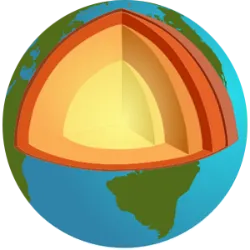
The Structure of the Earth

At the core, located at the center of the planet, there are two parts: the inner core, solid and primarily made of iron and nickel, and the outer core, liquid, responsible for generating Earth’s magnetic field. Above the core lies the mantle, a thick layer of hot and semi-solid rocks that move slowly, causing phenomena such as volcanoes and earthquakes. The outermost part is the crust, thin and rigid, where we live; it is divided into the continental crust, thicker and composed of granite, and the oceanic crust, thinner and made of basalt. Between the crust and the mantle is the asthenosphere, a partially melted region that allows tectonic plates to move. These layers constantly interact, shaping the planet’s surface, forming mountains, valleys, volcanoes, and oceans. Studying Earth’s structure is essential to understanding natural phenomena, exploring mineral resources, and assessing geological risks. In this way, the planet reveals a continuous internal dynamic that sustains life and transforms the landscape over time.



---publicity---
---article---


Those who liked The Structure of the Earth, also liked to explore GEOGRAPHY

Explore more about Livestock is one of the oldest activities of humanity, with the aim of producing food and other raw materials. The main products generated by this practice are meat, milk, eggs, honey, leather, bones and wool. There are two basic types of livestock: intensive and extensive. There are two types: beef cattle farming focuses on meat production, while dairy farming focuses on milk production. Agriculture is the term used to designate the junction between animal husbandry and vegetable cultivation...

Livestock is one of the oldest activities of humanity, with the aim of producing food and other raw materials. The main products generated by this practice are meat, milk, eggs, honey, leather, bones and wool. There are two basic types of livestock: intensive and extensive. There are two types: beef cattle farming focuses on meat production, while dairy farming focuses on milk production. Agriculture..


Analyzing and understanding th - About LANDSCAPES AND MAPS

Explore more about Analyzing and understanding the landscape can be done through direct observation (visualizing the phenomenon on site) or indirect observation (studying the phenomenon through written, visual, informative documents, etc.). This process requires skill in organizing information, and geographers often use landscape sketching as a technique to schematize information into three observation planes, facilitating the description of the landscape. 3rd Plane: Corresponds to the most distant part of the observer. Natural elements such as the Black Sea and the sky. Human elements: none. 2nd Plane: Located in the middle portion of the landscape. Natural elements: Black Sea and hill. Human elements: houses. 1st Plane: Closer to the observer, providing a more detailed view. It includes natural elements such as the Black Sea, vegetation and cliffs, along with human elements such as houses and a bridge...

Analyzing and understanding the landscape can be done through direct observation (visualizing the phenomenon on site) or indirect observation (studying the phenomenon through written, visual, informative documents, etc.). This process requires skill in organizing information, and geographers often use landscape sketching as a technique to schematize information into three observation planes, facilitating..


Minerals can be identified thr - About ROCKS AND MINERALS

Explore more about Minerals can be identified through simple tests that evaluate characteristics such as color, brightness, trace, hardness, cleavage and reaction with acids. Color, although observable, is of little use in identification, as a mineral can have different colors. The shine can be metallic or non-metallic, depending on the light reflection. The trace refers to the color of the powder left by the mineral when it scratches a surface. Hardness, measured by the Mohs scale, indicates resistance to scratching, with harder minerals scratching softer ones. Cleavage, a mineral exhibits cleavage when it breaks, under the action of a force, along well-defined plane surfaces. Reaction with acids refers to the ability of some minerals to react with acids, producing effervescence. For example, calcite reacts with acid, releasing bubbles of carbon dioxide...

Minerals can be identified through simple tests that evaluate characteristics such as color, brightness, trace, hardness, cleavage and reaction with acids. Color, although observable, is of little use in identification, as a mineral can have different colors. The shine can be metallic or non-metallic, depending on the light reflection. The trace refers to the color of the powder left by the mineral..


The digestive system is made u - About NATURAL SCIENCES

Explore more about The digestive system is made up of organs that work together to allow the absorption of as many nutrients as possible from the food ingested. It is formed by the following organs: mouth, pharynx, esophagus, stomach, small intestine, large intestine and anus. In addition, it is connected to glands that release their secretion inside the digestive tract, they are: salivary glands, pancreas, liver and gallbladder...

The digestive system is made up of organs that work together to allow the absorption of as many nutrients as possible from the food ingested. It is formed by the following organs: mouth, pharynx, esophagus, stomach, small intestine, large intestine and anus. In addition, it is connected to glands that release their secretion inside the digestive tract, they are: salivary glands, pancreas, liver and..


The Fall of the Roman Empire i - About HISTORY

Explore more about The Fall of the Roman Empire in 476 AD is one of the most significant milestones in history, representing the end of Antiquity and the beginning of the Middle Ages. The Empire, which once controlled vast areas of Europe, North Africa and Western Asia, declined due to a combination of factors that weakened its structure. 
Internally, the empire faced political instability, with frequent changes of emperors and widespread administrative corruption. Government inefficiency and growing social inequality also contributed to its collapse. In addition, difficulties in maintaining the borders and military pressure further weakened the Roman structure. Externally, barbarian invaders such as the Visigoths, Vandals and Ostrogoths repeatedly attacked the Roman borders. The sack of Rome by Alaric in 410 AD and the invasion of the Vandals in 455 AD were decisive events, culminating in the deposition of the last Roman emperor, Romulus Augustulus, by Odoacer in 476 AD.
After its fall, the Western Roman Empire was fragmented, giving rise to barbarian kingdoms such as the Franks and Visigoths. Although the period has been called the Dark Ages, it was also an era of important transformations. With its capital in Constantinople, it survived until 1453, profoundly changing the politics and social organization of the Western world...

The Fall of the Roman Empire in 476 AD is one of the most significant milestones in history, representing the end of Antiquity and the beginning of the Middle Ages. The Empire, which once controlled vast areas of Europe, North Africa and Western Asia, declined due to a combination of factors that weakened its structure.
Internally, the empire faced political instability, with frequent changes..

publicity


Those who liked The Structure of the Earth, also liked to explore ACADEMIC

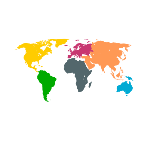
Explore more about The planet Earth is made up of six large continents, which are vast landmasses surrounded by oceans and seas.
These continents are:
🌎 America.
🌍 Africa.
🌍 Europe.
🌏 Asia.
🌏 Oceania.
❄️ Antarctica.
Relationship with oceans:
The continents are surrounded by:
oceans.
seas.
and areas such as the continental shelf, which extends under the water.
Characteristics of each continent:
🌍 Africa:
partly located in the Southern Hemisphere.
considered the 3rd largest continent.
has great diversity of landscapes and cultures.
🌎 America:
located entirely in the Western Hemisphere.
is the 2nd largest continent on Earth.
🌏 Asia:
located in the Eastern Hemisphere.
mostly in the Northern Hemisphere.
is the largest continent in both area and population.
🌍 Europe:
has about 50 countries.
is the 2nd smallest continent in size.
🌏 Oceania:
located in the Southern and Western Hemispheres.
is the smallest continent in area.
also has the smallest population.
❄️ Antarctica:
located at the South Pole.
has no permanent population.
mostly covered by ice throughout the year...

The planet Earth is made up of six large continents, which are vast landmasses surrounded by oceans and seas.
These continents are:
🌎 America.
🌍 Africa.
🌍 Europe.
🌏 Asia.
🌏 Oceania.
❄️ Antarctica.
Relationship with oceans:
The continents are surrounded by:
oceans.
seas.
and areas such as the continental shelf, which extends..


The eighth day of the competit - About WORLD CUP

Explore more about The eighth day of the competition:
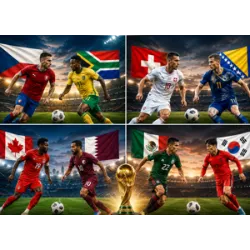
The eighth day of the 2026 FIFA World Cup brings together Group A teams and other sides in matches yet to be played, with all fixtures starting on equal terms at 0 x 0 on the scoreboard. The round promises balance, intensity, and direct importance in the fight for qualification.
Czechia 0 x 0 South Africa:
Atlanta, USA – 12:00 local time
Czechia relies on defensive organization and strength in midfield.
South Africa uses speed and quick transitions.
How it will be:
Balanced match, with a slight advantage in African speed, but Czech tactical control.
Switzerland 0 x 0 Bosnia and Herzegovina:
Los Angeles, USA – 12:00 local time
Switzerland is consistent, compact, and efficient.
Bosnia relies on physical play and direct football.
How it will be:
Tight contest, with few gaps and intense midfield battle.
Canada 0 x 0 Qatar:
Vancouver, Canada – 15:00 local time
Canada plays with intensity and home support.
Qatar relies on possession and organization.
How it will be:
Canada presses more, Qatar tries to control the tempo with possession.
Mexico 0 x 0 South Korea:
Guadalajara, Mexico – 19:00 local time
Mexico relies on attacking creativity and high pressing.
South Korea uses tactical discipline and speed.
How it will be:
Very balanced match, with chances for both sides and high tempo.
End of the day:
The eighth day of the 2026 FIFA World Cup presents matches yet to be played, but with high expectations of balance and intensity. Teams enter the field with clear goals of earning points and advancing in the competition, making each match crucial for the tournament’s future.
The round is expected to feature tactical battles, high physical effort, and constant pressure moments, as any detail may decide the result. Teams aim for efficiency in finishing and defensive solidity to secure an advantage.
With different playing styles in opposition, the day promises competitive matches until the final whistle, maintaining a high level of competition and an open fight in the standings...

The eighth day of the competition:
The eighth day of the 2026 FIFA World Cup brings together Group A teams and other sides in matches yet to be played, with all fixtures starting on equal terms at 0 x 0 on the scoreboard. The round promises balance, intensity, and direct importance in the fight for qualification.
Czechia 0 x 0 South Africa:
Atlanta, USA – 12:00 local time
Czechia..


The tournament gains momentum - About WORLD CUP

Explore more about The tournament gains momentum
After the opening day of the 2026 World Cup, the second day of competition shifts attention to two host nations making their tournament debuts in front of home fans.

The first results begin to shape the groups and increase the pressure for a positive start to the competition.

Canada vs Bosnia and Herzegovina (Group B)
BMO Field – Toronto

Host nation debut

Canada begins its campaign surrounded by high expectations and backed by strong local support.

The team is expected to play with intensity from the opening minutes, seeking to control possession and apply pressure in the attacking half.

Bosnia and Herzegovina arrives motivated after a strong qualifying campaign and will rely on the experience of its key players to challenge the hosts.

United States vs Paraguay (Group D)

Home pressure

The United States enters the match in front of a large crowd and carries the responsibility of starting the tournament with a positive result.

The team is expected to rely on pace on the wings and quick transitions to create opportunities.

Paraguay will count on its traditional defensive organization and competitive spirit, making this a potentially unpredictable contest.

How it went
(This section will be updated after the matches.)

Canada vs Bosnia and Herzegovina
How it went: Canada drew 1-1 with Bosnia and Herzegovina in its opening match of the 2026 World Cup in Toronto.

Bosnia and Herzegovina opened the scoring in the 21st minute through Jovo Lukic, who took advantage of a set-piece situation to put his team ahead.

United States vs Paraguay
How it went: The match featured moments of balance and intensity, with the United States trying to dictate the tempo of play.

Paraguay remained competitive throughout the contest and made it difficult for the hosts to create clear chances.
..

The tournament gains momentum
After the opening day of the 2026 World Cup, the second day of competition shifts attention to two host nations making their tournament debuts in front of home fans.
The first results begin to shape the groups and increase the pressure for a positive start to the competition.
Canada vs Bosnia and Herzegovina (Group B)
BMO Field – Toronto
Host..


The sixth day of the competiti - About WORLD CUP

Explore more about The sixth day of the competition:
The sixth day of the 2026 FIFA World Cup brought together teams with different ambitions in the tournament and was marked by important matches for the definition of the groups. The matchday featured decisive clashes and reinforced the favoritism of some teams.
Austria 3 x 1 Jordan:
Santa Clara (San Francisco Bay Area), USA – 21:00 local time
Austria confirmed its superiority by relying on tactical organization, intensity, and good build-up play through midfield.
Jordan tried to respond with defensive discipline and fast transitions, but had difficulty containing the opponent.
How it went:
Austria took control of possession for much of the match, set the tempo of the game, and turned dominance into goals. Jordan managed to pull one back, but did not have enough strength to react.
France 3 x 1 Senegal:
New York/New Jersey, USA – 15:00 local time
France showed why it is considered one of the title favorites, using its technical quality, attacking strength, and experience in major competitions.
Senegal relied on physical intensity, speed, and collective organization to balance the match.
How it went:
The French national team had greater territorial dominance and control of possession. Senegal created difficulties at times, especially in quick transitions, but France’s attacking efficiency made the difference.
Iraq 1 x 4 Norway:
Boston, USA – 18:00 local time
Iraq entered the match seeking competitiveness with tactical discipline and strong defensive commitment.
Norway relied on its technical quality, physical strength, and finishing ability.
How it went:
The Norwegian team confirmed its favoritism and was superior for most of the game. Even facing resistance from Iraq at times, Norway made better use of its chances and won convincingly.
Argentina 3 x 0 Algeria:
Kansas City, USA – 20:00 local time
Argentina relied on its tradition, individual talent, and experience in decisive matches.
Algeria tried to surprise with pace on the wings and attacking intensity.
How it went:
The Argentine national team controlled possession, took charge of the match, and neutralized the opponent’s attempts. With a consistent performance in both halves, it secured a solid victory...

The sixth day of the competition:
The sixth day of the 2026 FIFA World Cup brought together teams with different ambitions in the tournament and was marked by important matches for the definition of the groups. The matchday featured decisive clashes and reinforced the favoritism of some teams.
Austria 3 x 1 Jordan:
Santa Clara (San Francisco Bay Area), USA – 21:00 local..


Carbon dioxide (CO₂) is a gas - About ACADEMIC

Explore more about Carbon dioxide (CO₂) is a gas that can change its state under specific temperature and pressure conditions.
Formation of dry ice:
When CO₂ is cooled below:
❄️ −78 °C
it solidifies and becomes known as:
🧊 dry ice
What happens when dry ice is heated?
At normal atmospheric pressure:
dry ice does not become liquid.
it changes directly from solid to gas.
This process is called:
Sublimation.
When does CO₂ become liquid?
For CO₂ to become liquid, it requires:
pressure greater than 5 atmospheres.
White cloud effect.
When warm air comes into contact with dry ice:
CO₂ gas is rapidly released.
a dense white cloud forms near the ground.
👉 This effect is widely used in theaters and special effects.
Sublimation temperature:
CO₂ sublimates at:
194.7 K.
−78.5 °C.
−109.2 °F.
(at Earth’s atmospheric pressure).
Important precautions:
Dry ice requires care because:
it can cause cold burns on direct contact.
it should not be handled without protection.
Risks in enclosed spaces.
Although CO₂ is not highly toxic:
it can accumulate in closed environments.
it may cause hypercapnia (excess CO₂ in the blood).
this can affect breathing and health...

Carbon dioxide (CO₂) is a gas that can change its state under specific temperature and pressure conditions.
Formation of dry ice:
When CO₂ is cooled below:
❄️ −78 °C
it solidifies and becomes known as:
🧊 dry ice
What happens when dry ice is heated?
At normal atmospheric pressure:
dry ice does not become liquid.
it changes directly from solid..


The seventh day of the competi - About WORLD CUP

Explore more about The seventh day of the competition:
The seventh day of the 2026 World Cup brought together national teams from several continents, including favorites, strong European sides, and emerging teams. The matchday featured balanced contests and important games for the group standings.
Portugal 1 x 1 Democratic Republic of the Congo
Houston, USA – 12:00 PM
Portugal has technical quality and ball possession.
The Congo relies on physical strength and speed.
How it went:
Portugal controlled much of the game, while Congo exploited counterattacks and managed to keep the match balanced.
England 4 x 2 Croatia
Dallas, USA – 3:00 PM
England has a strong attack and squad depth.
Croatia relies on experience and midfield control.
How it went:
England pressed from the start and showed offensive efficiency. Croatia tried to control the tempo but could not avoid defeat.
Ghana 1 x 0 Panama
Toronto, Canada – 7:00 PM
Ghana uses speed and physical strength.
Panama defends in a low block.
How it went:
Ghana applied pressure for much of the match and found the winning goal against a resilient Panama side.
Uzbekistan 1 x 3 Colombia
Mexico City, Mexico – 8:00 PM
Uzbekistan is defensively organized.
Colombia has creativity and attacking quality.
How it went:
Colombia dominated possession and created more chances, confirming its offensive superiority throughout the match.
End of the day:
The day featured balanced matches and different playing styles. The favorites sought to confirm their status, while other teams tried to surprise. It was an intense and competitive matchday.
The matches proved important for qualification and directly influenced the next stage pairings, increasing the pressure on all teams on the field. Fans witnessed competitive games, moments of intensity, and some surprises throughout the day.
The teams also sought to manage their physical effort, as the schedule is demanding and any mistake can be decisive at this stage of the competition. Defensive consistency and attacking efficiency were key factors in securing positive results and keeping tournament ambitions alive.
Intense matches until the final whistle...

The seventh day of the competition:
The seventh day of the 2026 World Cup brought together national teams from several continents, including favorites, strong European sides, and emerging teams. The matchday featured balanced contests and important games for the group standings.
Portugal 1 x 1 Democratic Republic of the Congo
Houston, USA – 12:00 PM
Portugal has technical..


Start of the 2026 World Cup Th - About WORLD CUP

Explore more about Start of the 2026 World Cup
The 2026 World Cup opens a historic edition featuring 48 national teams and matches spread across multiple host countries.
Day 1 brings global attention with the opening ceremony and the first group-stage matches, officially marking the start of the tournament.

Opening ceremony
The opening ceremony marks the symbolic beginning of the tournament, featuring a spectacle focused on the culture of the host nations and a global celebration of football.
The show typically includes music, dance, and large-scale visual performances, setting the atmosphere for the first match of the competition.

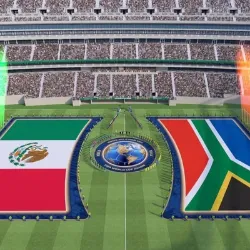
Mexico vs South Africa (Group A)
Estadio Azteca – Mexico City
Opening match
Mexico enters under strong pressure and massive home support, which is expected to drive an aggressive attacking approach from the start.
The team should aim to control possession and impose high intensity in the attacking half.
South Africa is expected to adopt a more reactive strategy, focusing on defensive organization and fast counter-attacks.

South Korea vs Czech Republic (Group B)
Balanced matchup
South Korea is expected to rely on high intensity, wide play, and strong tactical discipline.
The Czech Republic will likely focus on midfield balance, aerial strength, and quick transitional play.
The match is expected to be highly competitive, with small margins deciding the outcome.

How it went
(This section will be updated after the matches and the opening ceremony.)

Opening ceremony
How it went: The opening ceremony marked the official start of the 2026 World Cup with a cultural showcase celebrating unity among nations.
The event combined music, dance, and high-impact visual elements, creating the perfect atmosphere for kickoff.

Mexico vs South Africa
How it went: The match started at high intensity, with Mexico pushing forward aggressively in front of their home crowd.
South Africa responded with solid defensive organization and managed to balance the game at several stages.

South Korea vs Czech Republic
How it went: The match was defined by intensity and balance, with both teams alternating periods of control throughout the game...

Start of the 2026 World Cup
The 2026 World Cup opens a historic edition featuring 48 national teams and matches spread across multiple host countries.
Day 1 brings global attention with the opening ceremony and the first group-stage matches, officially marking the start of the tournament.
Opening ceremony
The opening ceremony marks the symbolic beginning of the tournament,..


The third day of competition T - About WORLD CUP

Explore more about The third day of competition
The third day of the 2026 World Cup features four important matches spread across the West and East Coasts of the United States and Canada. With debuts and direct clashes, teams begin to feel the pressure of the group stage.

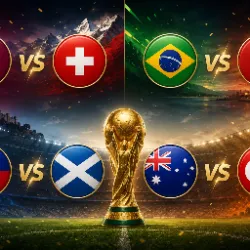
Qatar vs Switzerland (Group B)
Santa Clara – 12:00 PT

Qatar looks to surprise with defensive organization and quick counterattacks.
Switzerland relies on consistency and control of the game.

How it will be
Likely Swiss dominance, with Qatar looking for space on the break.

Brazil vs Morocco (Group C)
New York / New Jersey – 18:00 ET

Brazil aims to impose possession and attacking creativity.
Morocco relies on defensive solidity and fast transitions.

How it will be
Brazil should control more of the game, while Morocco remains dangerous on counters.

Haiti vs Scotland (Group C)
Boston – 21:00 ET

Haiti plays with physical intensity and high pace.
Scotland relies on organization and collective experience.

How it will be
A balanced and physical match, likely decided by small details.

Australia vs Turkey (Group D)
Vancouver – 21:00 PT

Australia relies on strength and direct play.
Turkey brings more technical quality and attacking variation.

How it will be
A balanced clash with strong midfield battles.

End of the day
A day marked by balance and contrasting styles, with matches likely decided by fine margins...

The third day of competition
The third day of the 2026 World Cup features four important matches spread across the West and East Coasts of the United States and Canada. With debuts and direct clashes, teams begin to feel the pressure of the group stage.
Qatar vs Switzerland (Group B)
Santa Clara – 12:00 PT
Qatar looks to surprise with defensive organization and quick..


The fourth day of the competit - About WORLD CUP

Explore more about The fourth day of the competition:
The fourth day of the 2026 World Cup was marked by plenty of goals, balanced matches, and important results in Groups E and F. Between dominant victories and closely contested games, the round began to shape the situation of the teams in the tournament.

Germany 7 x 1 Curaçao (Group E):
Houston, Texas – 12:00 (CDT)
Germany confirmed its favoritism with a dominant performance, controlling possession and creating numerous chances.
How the match went:
The Germans were superior throughout the game and turned their dominance into a 7-1 victory. Curaçao managed to score once but could not avoid a heavy defeat.

Netherlands 2 x 2 Japan (Group F)
Arlington/Dallas, Texas – 15:00 (CDT)
The clash between the Dutch and the Japanese was one of the most balanced matches of the round. The Netherlands enjoyed more possession, while Japan responded with speed and organization.
How the match went:
The game was intense and entertaining. Both teams alternated periods of control and created good chances, finishing with a 2-2 draw.

Ivory Coast 1 x 0 Ecuador (Group E):
Philadelphia, Pennsylvania – 19:00 (EDT)
Ivory Coast and Ecuador played a balanced match, heavily contested in midfield.
How the match went:
With few clear scoring opportunities, the match was decided by fine margins. Ivory Coast took advantage of one chance and secured a 1-0 victory.

Sweden 5 x 1 Tunisia (Group F):
Monterrey, Mexico – 21:00 (CDT)
Sweden showed organization, experience, and attacking efficiency against Tunisia.
How the match went:
The Swedes dominated much of the contest and converted their chances into goals, securing a convincing 5-1 victory.

End of the day:
The round ended with two emphatic wins, an exciting draw, and a narrow victory. Germany and Sweden impressed with their attacking power, Ivory Coast earned three valuable points, and the Netherlands and Japan produced one of the most balanced matches of the tournament...

The fourth day of the competition:
The fourth day of the 2026 World Cup was marked by plenty of goals, balanced matches, and important results in Groups E and F. Between dominant victories and closely contested games, the round began to shape the situation of the teams in the tournament.
Germany 7 x 1 Curaçao (Group E):
Houston, Texas – 12:00 (CDT)
Germany confirmed..


The fifth day of the competiti - About WORLD CUP

Explore more about The fifth day of the competition:
The fifth day of the 2026 FIFA World Cup was marked by balance and surprises. In different cities across the United States, traditional national teams and emerging sides played highly competitive matches, keeping the excitement of the group stage alive.
Spain 0 vs 0 Cape Verde:
Atlanta, USA – 12:00 PM local time
Spain dominated possession and created the best chances of the match but struggled to break through a well-organized defense.
How it went:
Cape Verde displayed excellent defensive organization and resisted Spanish pressure throughout the 90 minutes, securing a goalless draw and a historic result.
Iran 2 vs 2 New Zealand:
Los Angeles, USA – 6:00 PM local time
Iran and New Zealand produced an intense and evenly contested match, with both teams enjoying periods of superiority.
How it went:
The 2-2 draw reflected the balance of the game. Iran relied on tactical organization, while New Zealand responded with efficiency and physical strength to earn an important point.
Belgium 1 vs 1 Egypt:
Seattle, USA – 12:00 PM local time
Belgium tried to impose its rhythm from the start, while Egypt relied on speed and attacking transitions.
How it went:
In a closely contested match, the teams drew 1-1. Belgium enjoyed more possession, but Egypt made the most of its opportunities and held on until the final whistle.
Saudi Arabia 1 vs 1 Uruguay:
Miami, USA – 6:00 PM local time
Uruguay looked to control the match, while Saudi Arabia relied on tactical discipline and collective play.
How it went:
The match ended in a 1-1 draw. Saudi Arabia showed efficiency and competitiveness to secure a valuable point against a traditional opponent.
End of the day:
The round ended without victories for the favorites, with four draws highlighting the competitiveness of the tournament. The results leave qualification for the next stage completely open...

The fifth day of the competition:
The fifth day of the 2026 FIFA World Cup was marked by balance and surprises. In different cities across the United States, traditional national teams and emerging sides played highly competitive matches, keeping the excitement of the group stage alive.
Spain 0 vs 0 Cape Verde:
Atlanta, USA – 12:00 PM local time
Spain dominated possession..

---publicity---
Betspot.zone is a fun quizzes and games site — not related to gambling or betting.