
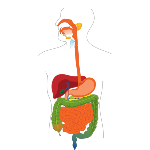
The digestive system
The digestive system is made up of organs that work together to allow the absorption of as many nutrients as possible from the food ingested

Reproduction is the biological function responsible for ensuring the continuity of life in all living beings.
Reproduction in humans:
In humans, reproduction is sexual, meaning:
it occurs through the union of two sex cells:
🧬 female: oocyte.
🧬 male: sperm cell.
from this union, a new human being is formed.
How is sex identified at birth?
At birth,..know more

They are fossils of organisms that show characteristics between ancient and more modern forms.
They help explain how certain species evolved gradually.
They work as “clues” to the evolution of living beings.
What do they show?
These fossils reveal changes that happened slowly over millions of years.
They show how new characteristics appeared little by little.
For..know more

Carbon dioxide (CO₂) is a gas that can change its state under specific temperature and pressure conditions.
Formation of dry ice:
When CO₂ is cooled below:
❄️ −78 °C
it solidifies and becomes known as:
🧊 dry ice
What happens when dry ice is heated?
At normal atmospheric pressure:
dry ice does not become liquid.
it changes directly from solid..know more

The Black Dinner was a violent historical event that took place in 1440 in Scotland, during the reign of King James II. It became known as a symbol of political betrayal among the Scottish nobility.
Historical context:
King James II was still young and ruling during a politically unstable period.
He was concerned about possible noble conspiracies against the crown.
His father,..know more

Adolescence begins with puberty, a stage of major changes in both the body and the mind.
When does puberty start?
👧 Girls: between 8 and 14 years old.
👦 Boys: between 9 and 15 years old.
What changes during this stage?
Puberty involves not only physical changes but also:
🧠 Psychological changes (emotions and behavior).
🤝 Social and relational changes..know more

Hyperautomation is an evolution of traditional automation.
It uses different technologies to automate tasks and processes.
It combines resources such as:
artificial intelligence (AI).
process automation.
data analysis.
system integration.
The goal is to reduce manual work and increase operational efficiency.
How does it work?
Hyperautomation identifies..know more

A natural landscape is formed by all elements of a space that exist without direct human interference.
Characteristics of natural landscapes:
It is composed of elements that:
🌱 have not been modified by humans.
🌄 exist naturally in the environment.
🌊 are part of the planet’s natural processes.
Examples of natural landscapes:
We can observe natural..know more
Ancient Egyptian civilization was one of the longest-lasting in history and developed in northeastern Africa, around the Nile River. Its growth happened thanks to fertile land, agricultural development, and expanding trade.
Where did Ancient Egypt emerge?
Egyptian civilization flourished in northeastern Africa.
It developed along the banks of the Nile River.
It was located..know more

The planet Earth is made up of six large continents, which are vast landmasses surrounded by oceans and seas.
These continents are:
🌎 America.
🌍 Africa.
🌍 Europe.
🌏 Asia.
🌏 Oceania.
❄️ Antarctica.
Relationship with oceans:
The continents are surrounded by:
oceans.
seas.
and areas such as the continental shelf, which extends..know more

A humanized landscape is one that results from human action on the natural environment.
Characteristics of a humanized landscape:
It is composed of elements that:
🏗️ have been built or modified by humans.
🌿 replace or alter natural elements.
🌆 reflect the organization of human activities in space.
How is it formed?
A humanized landscape is created..know more