betspot.zone logo
🧠 Educational content • Interactive quizzes
Biochemistry >> 

Enzymology: Enzyme Kinetics

Enzymology studies enzymes and their mechanisms of action, which are fundamental to biochemical reactions in living organisms

Enzymology: Enzyme Kinetics
pngwing.com

Enzyme kinetics investigates how enzymes catalyze reactions and how variables influence their activity. The Michaelis-Menten model is the basis for understanding this process, describing the relationship between substrate concentration and the rate of the enzymatic reaction.

According to this model, the reaction rate increases with substrate concentration until it reaches a saturation point, when all enzymes are occupied. This point is represented by the maximum velocity (Vmax). The Michaelis constant (Km) indicates the affinity of the enzyme for the substrate; lower values ​​of Km indicate greater affinity.

Several factors can affect enzyme activity, including temperature, pH, and the presence of inhibitors or activators. Increasing the temperature generally accelerates the reaction up to a certain limit, after which the enzyme may denature. The pH must also be adequate for the enzyme to maintain its active structure. Inhibitors can reduce enzyme activity, while activators increase it. Understanding these factors is essential for many areas of biotechnology and medicine.

Did you know?


---publicity---
---article---


Those who liked Enzymology: Enzyme Kinetics, also liked to explore

Explore more about Biological membranes play a vital role in the protection, communication and transport of substances within and outside cells. The fluid mosaic model, proposed by Singer and Nicolson in 1972, describes the dynamic and complex structure of cell membranes. According to this model, the membrane is composed of a lipid bilayer, with proteins dispersed in a mosaic-like pattern that move laterally, giving the structure fluidity.
The lipid bilayer, formed by phospholipids, is the basis of the membrane, with its hydrophobic tails facing inward and its hydrophilic heads facing outward. Proteins, which can be integral or peripheral, perform crucial functions such as transport, cell signaling and anchoring structures. Integral proteins span the entire lipid bilayer, while peripheral proteins are located on the membrane surface.
This model explains the flexibility of membranes, which allows changes in shape, the movement of lipids and proteins, and adaptation to different environmental conditions. Membrane fluidity is essential for processes such as endocytosis, exocytosis, and the function of ion channels, ensuring efficient interaction between the cell and its environment...

Biological membranes play a vital role in the protection, communication and transport of substances within and outside cells. The fluid mosaic model, proposed by Singer and Nicolson in 1972, describes the dynamic and complex structure of cell membranes. According to this model, the membrane is composed of a lipid bilayer, with proteins dispersed in a mosaic-like pattern that move laterally, giving..know more


The digestive system is made u - About

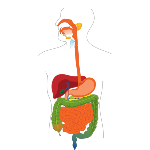
Explore more about The digestive system is made up of organs that work together to allow the absorption of as many nutrients as possible from the food ingested. It is formed by the following organs: mouth, pharynx, esophagus, stomach, small intestine, large intestine and anus. In addition, it is connected to glands that release their secretion inside the digestive tract, they are: salivary glands, pancreas, liver and gallbladder...

The digestive system is made up of organs that work together to allow the absorption of as many nutrients as possible from the food ingested. It is formed by the following organs: mouth, pharynx, esophagus, stomach, small intestine, large intestine and anus. In addition, it is connected to glands that release their secretion inside the digestive tract, they are: salivary glands, pancreas, liver and..know more


The Kingdom Plantae (Kingdom o - About

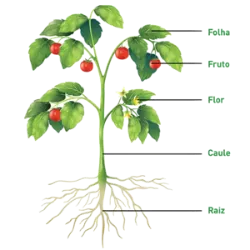
Explore more about The Kingdom Plantae (Kingdom of Plants) encompasses eukaryotic, multicellular, autotrophic (photosynthetic) beings with a cell wall rich in cellulose.
Main features:
Photosynthesis: They produce their food using sunlight, water and carbon dioxide.
Reproduction: Can be sexual (with gametes) or asexual (cloning, spores, budding).
Classification:
Bryophytes: Small, without conducting vessels (e.g. mosses).
Pteridophytes: They have vessels, but no seeds (e.g.: ferns).
Gymnosperms: "Naked" seeds, without fruit (e.g. pine trees).
Angiosperms: Seeds protected by fruits, flowers (e.g. fruit trees).
Plants are essential for environmental balance, providing oxygen, food and shelter. In education, studying this kingdom develops notions about ecology, biodiversity and sustainability...

The Kingdom Plantae (Kingdom of Plants) encompasses eukaryotic, multicellular, autotrophic (photosynthetic) beings with a cell wall rich in cellulose.
Main features:
Photosynthesis: They produce their food using sunlight, water and carbon dioxide.
Reproduction: Can be sexual (with gametes) or asexual (cloning, spores, budding).
Classification:
Bryophytes:..know more


Amphibians, a fascinating grou - About

Explore more about Amphibians, a fascinating group of vertebrate animals, are true survivors that move between the aquatic and terrestrial world. Composed of toads, frogs, tree frogs, salamanders and caecilians, this group plays a crucial role in ecosystems and is highlighted in studies on evolution and adaptation.
Unique Features
They have thin, moist, permeable skin, which makes them highly dependent on moist environments to survive. This special skin not only protects, but also allows cutaneous respiration, complementing lung respiration. During the larval stage, they generally breathe through gills and live exclusively in water, while adults migrate to dry land, adapting with lungs and strong legs to jump or swim.
Ecological Importance
These animals are important environmental indicators. Because they are sensitive to changes in the environment, their presence (or absence) warns about the health of ecosystems. Additionally, amphibians control insect populations, including agricultural pests and disease carriers such as mosquitoes.
Survival Challenges
Amphibians face serious threats such as deforestation, pollution, climate change and fungal diseases such as chytridiomycosis...

Amphibians, a fascinating group of vertebrate animals, are true survivors that move between the aquatic and terrestrial world. Composed of toads, frogs, tree frogs, salamanders and caecilians, this group plays a crucial role in ecosystems and is highlighted in studies on evolution and adaptation.
Unique Features
They have thin, moist, permeable skin, which makes them highly dependent..know more


Earth is a unique and extraord - About

Explore more about Earth is a unique and extraordinary planet, being the common home of all species, where we still enjoy the best conditions of comfort, sustenance and protection for life. However, it was not always like this. The planet we know today is the result of a complex process of transformations that began about 4.6 billion years ago. With the advancement of science and technology, human intelligence has made our species the most dominant, capable of influencing natural processes, consuming large amounts of resources and, thus, shaping the future of the planet. Now, we have the responsibility to ensure the survival of all the species that share the Earth with us...

Earth is a unique and extraordinary planet, being the common home of all species, where we still enjoy the best conditions of comfort, sustenance and protection for life. However, it was not always like this. The planet we know today is the result of a complex process of transformations that began about 4.6 billion years ago. With the advancement of science and technology, human intelligence has made..know more

publicity


Those who liked Enzymology: Enzyme Kinetics, also liked to explore

Explore more about Hyperautomation is an evolution of traditional automation.
It uses different technologies to automate tasks and processes.
It combines resources such as:
artificial intelligence (AI).
process automation.
data analysis.
system integration.
The goal is to reduce manual work and increase operational efficiency.

How does it work?
Hyperautomation identifies repetitive or time-consuming tasks.
Then, automated systems perform these activities with little or no human intervention.
It can:
execute tasks automatically.
analyze information.
identify patterns.
support business decisions.

Benefits of Hyperautomation
This technology can bring several improvements to companies, such as:
reduction of human errors.
faster processes.
fewer repetitive and tiring tasks.
higher productivity.
better integration between systems and teams.
support for decision-making.
This helps companies work in a more organized and efficient way.

Error reduction and increased efficiency
Many manual tasks can lead to human errors.
With hyperautomation:
processes become more standardized.
repetitive activities are automated.
the risk of errors decreases.
This increases operational accuracy.

Smarter decision-making
Hyperautomation also helps leaders and teams make decisions.
Systems can:
analyze large volumes of data.
generate information quickly.
identify trends and patterns.
provide support for more strategic decisions.

Communication between people and systems
Another advantage is improving integration within companies.
The technology facilitates:
information sharing.
connection between departments.
communication between employees and digital systems.
This reduces rework and improves workflow.

Where is hyperautomation used?
It can be applied in many sectors, such as:
manufacturing.
healthcare.
technology.
logistics.
finance.
customer service.
Virtually any company can use hyperautomation to optimize processes...

Hyperautomation is an evolution of traditional automation.
It uses different technologies to automate tasks and processes.
It combines resources such as:
artificial intelligence (AI).
process automation.
data analysis.
system integration.
The goal is to reduce manual work and increase operational efficiency.
How does it work?
Hyperautomation identifies..know more


The planet Earth is made up of - About

Explore more about The planet Earth is made up of six large continents, which are vast landmasses surrounded by oceans and seas.
These continents are:
🌎 America.
🌍 Africa.
🌍 Europe.
🌏 Asia.
🌏 Oceania.
❄️ Antarctica.
Relationship with oceans:
The continents are surrounded by:
oceans.
seas.
and areas such as the continental shelf, which extends under the water.
Characteristics of each continent:
🌍 Africa:
partly located in the Southern Hemisphere.
considered the 3rd largest continent.
has great diversity of landscapes and cultures.
🌎 America:
located entirely in the Western Hemisphere.
is the 2nd largest continent on Earth.
🌏 Asia:
located in the Eastern Hemisphere.
mostly in the Northern Hemisphere.
is the largest continent in both area and population.
🌍 Europe:
has about 50 countries.
is the 2nd smallest continent in size.
🌏 Oceania:
located in the Southern and Western Hemispheres.
is the smallest continent in area.
also has the smallest population.
❄️ Antarctica:
located at the South Pole.
has no permanent population.
mostly covered by ice throughout the year...

The planet Earth is made up of six large continents, which are vast landmasses surrounded by oceans and seas.
These continents are:
🌎 America.
🌍 Africa.
🌍 Europe.
🌏 Asia.
🌏 Oceania.
❄️ Antarctica.
Relationship with oceans:
The continents are surrounded by:
oceans.
seas.
and areas such as the continental shelf, which extends..know more


Adolescence begins with pubert - About

Explore more about Adolescence begins with puberty, a stage of major changes in both the body and the mind.
When does puberty start?
👧 Girls: between 8 and 14 years old.
👦 Boys: between 9 and 15 years old.
What changes during this stage?
Puberty involves not only physical changes but also:
🧠 Psychological changes (emotions and behavior).
🤝 Social and relational changes (how people interact with others).
🧍‍♂️ Physical changes (transformations in the body).
The role of hormones:
During this stage, hormones become active. They act as the body’s “chemical messengers”:
👦 Testosterone (in boys).
👧 Estrogen and progesterone (in girls).
In childhood, these hormones are mostly inactive, but during puberty they become highly active.
What do hormones do?
They are responsible for:
activating secondary sexual characteristics.
shaping adult physical traits.
causing changes in body appearance and structure.
Acne during adolescence:
During adolescence, it is common to develop:
Acne (skin pimples).
This happens because:
there is an increase in sebum (skin oil) production.
sebaceous glands become more active.
pores can become blocked and inflamed...

Adolescence begins with puberty, a stage of major changes in both the body and the mind.
When does puberty start?
👧 Girls: between 8 and 14 years old.
👦 Boys: between 9 and 15 years old.
What changes during this stage?
Puberty involves not only physical changes but also:
🧠 Psychological changes (emotions and behavior).
🤝 Social and relational changes..know more


Reproduction is the biological - About

Explore more about Reproduction is the biological function responsible for ensuring the continuity of life in all living beings.
Reproduction in humans:
In humans, reproduction is sexual, meaning:
it occurs through the union of two sex cells:
🧬 female: oocyte.
🧬 male: sperm cell.
from this union, a new human being is formed.
How is sex identified at birth?
At birth, a baby’s sex is identified by observing the genital organs.
These organs are called:
Primary sexual characteristics:
They are the reproductive organs present from birth:
male: penis.
female: vagina.
Body changes during growth.
As time passes, especially during adolescence, the body undergoes external transformations.
These changes are called:
Secondary sexual characteristics:
They are not directly related to reproductive organs, but help distinguish boys and girls.
Examples:
hair growth.
voice change.
breast development.
changes in body structure...

Reproduction is the biological function responsible for ensuring the continuity of life in all living beings.
Reproduction in humans:
In humans, reproduction is sexual, meaning:
it occurs through the union of two sex cells:
🧬 female: oocyte.
🧬 male: sperm cell.
from this union, a new human being is formed.
How is sex identified at birth?
At birth,..know more


Carbon dioxide (CO₂) is a gas - About

Explore more about Carbon dioxide (CO₂) is a gas that can change its state under specific temperature and pressure conditions.
Formation of dry ice:
When CO₂ is cooled below:
❄️ −78 °C
it solidifies and becomes known as:
🧊 dry ice
What happens when dry ice is heated?
At normal atmospheric pressure:
dry ice does not become liquid.
it changes directly from solid to gas.
This process is called:
Sublimation.
When does CO₂ become liquid?
For CO₂ to become liquid, it requires:
pressure greater than 5 atmospheres.
White cloud effect.
When warm air comes into contact with dry ice:
CO₂ gas is rapidly released.
a dense white cloud forms near the ground.
👉 This effect is widely used in theaters and special effects.
Sublimation temperature:
CO₂ sublimates at:
194.7 K.
−78.5 °C.
−109.2 °F.
(at Earth’s atmospheric pressure).
Important precautions:
Dry ice requires care because:
it can cause cold burns on direct contact.
it should not be handled without protection.
Risks in enclosed spaces.
Although CO₂ is not highly toxic:
it can accumulate in closed environments.
it may cause hypercapnia (excess CO₂ in the blood).
this can affect breathing and health...

Carbon dioxide (CO₂) is a gas that can change its state under specific temperature and pressure conditions.
Formation of dry ice:
When CO₂ is cooled below:
❄️ −78 °C
it solidifies and becomes known as:
🧊 dry ice
What happens when dry ice is heated?
At normal atmospheric pressure:
dry ice does not become liquid.
it changes directly from solid..know more


A natural landscape is formed - About

Explore more about A natural landscape is formed by all elements of a space that exist without direct human interference.
Characteristics of natural landscapes:
It is composed of elements that:
🌱 have not been modified by humans.
🌄 exist naturally in the environment.
🌊 are part of the planet’s natural processes.
Examples of natural landscapes:
We can observe natural landscapes in:
🌳 forests.
🏜️ deserts.
🌋 volcanic areas.
🏔️ mountains.
🌊 rivers and oceans.
What is NOT a natural landscape?
When there is human interference, the landscape is no longer considered natural.
Examples:
🏙️ cities.
🛣️ roads.
🌾 plantations.
🏗️ buildings...

A natural landscape is formed by all elements of a space that exist without direct human interference.
Characteristics of natural landscapes:
It is composed of elements that:
🌱 have not been modified by humans.
🌄 exist naturally in the environment.
🌊 are part of the planet’s natural processes.
Examples of natural landscapes:
We can observe natural..know more


The Black Dinner was a violent - About

Explore more about The Black Dinner was a violent historical event that took place in 1440 in Scotland, during the reign of King James II. It became known as a symbol of political betrayal among the Scottish nobility.
Historical context:
King James II was still young and ruling during a politically unstable period.
He was concerned about possible noble conspiracies against the crown.
His father, James I, had been murdered by members of the nobility, increasing distrust within the kingdom.
The invitation to the banquet:
The king invited William Douglas (16 years old) and his younger brother to a dinner at the castle.
The event appeared to be a political meeting and reconciliation.
The sign of tragedy:
During the banquet:
A black bull’s head was placed on the table.
This symbol represented an imminent death sentence.
The outcome:
Despite the king’s attempts to avoid escalation, political forces had already decided the outcome.
The Douglas brothers were arrested and executed by beheading shortly after the dinner.
Historical significance:
The event became known as the “Black Dinner” (Black Dinner).
It represents:
political betrayal.
instability among the nobility.
power struggles in medieval Scotland...

The Black Dinner was a violent historical event that took place in 1440 in Scotland, during the reign of King James II. It became known as a symbol of political betrayal among the Scottish nobility.
Historical context:
King James II was still young and ruling during a politically unstable period.
He was concerned about possible noble conspiracies against the crown.
His father,..know more


They are fossils of organisms - About

Explore more about They are fossils of organisms that show characteristics between ancient and more modern forms.
They help explain how certain species evolved gradually.
They work as “clues” to the evolution of living beings.

What do they show?
These fossils reveal changes that happened slowly over millions of years.
They show how new characteristics appeared little by little.
For example:
body changes.
new adaptations.
transformations in bone structure.

Example: bird evolution
Transitional fossils help show the link between some dinosaurs and modern birds.
They indicate that certain groups of dinosaurs gradually developed:
hollow bones.
feathers.
flight-related characteristics.
This helps explain how modern birds originated.

Example: turtle evolution
Turtles are an important case studied through transitional fossils.
Their origin once seemed difficult to explain, but fossil discoveries helped reconstruct this process.

Early ancestors
The earliest turtle ancestors had:
wide ribs.
no complete shell.
They did not yet have the typical structure of modern turtles.

Pappochelys
Pappochelys represented an intermediate stage of evolution.
It had:
gastralia (belly ribs).
structures that would help form the plastron.
The plastron is the lower part of the shell.

Odontochelys
Odontochelys already had:
a developed plastron.
teeth.
This feature differentiates it from modern turtles, which do not have teeth.

Proganochelys
Proganochelys showed an important advancement.
It is where the carapace appeared:
the upper part of the shell on the back.
This development occurred about 214 million years ago.

What do these findings teach us?
Transitional fossils show that evolution happens slowly.
Species change gradually over time.
New characteristics appear in stages, until modern animals are formed...

They are fossils of organisms that show characteristics between ancient and more modern forms.
They help explain how certain species evolved gradually.
They work as “clues” to the evolution of living beings.
What do they show?
These fossils reveal changes that happened slowly over millions of years.
They show how new characteristics appeared little by little.
For..know more


A humanized landscape is one t - About

Explore more about A humanized landscape is one that results from human action on the natural environment.
Characteristics of a humanized landscape:
It is composed of elements that:
🏗️ have been built or modified by humans.
🌿 replace or alter natural elements.
🌆 reflect the organization of human activities in space.
How is it formed?
A humanized landscape is created through actions such as:
construction of buildings and cities.
building roads and bridges.
agriculture and land use.
destruction or alteration of natural habitats.
🌍 Natural vs. humanized landscape.
🌿 Natural: no human intervention.
🏙️ Humanized: modified by humans.
Other names:
A humanized landscape can also be called:
🏙️ urban landscape.
🎭 cultural landscape...

A humanized landscape is one that results from human action on the natural environment.
Characteristics of a humanized landscape:
It is composed of elements that:
🏗️ have been built or modified by humans.
🌿 replace or alter natural elements.
🌆 reflect the organization of human activities in space.
How is it formed?
A humanized landscape is created..know more


Ancient Egyptian civilization - About

Explore more about Ancient Egyptian civilization was one of the longest-lasting in history and developed in northeastern Africa, around the Nile River. Its growth happened thanks to fertile land, agricultural development, and expanding trade.
Where did Ancient Egypt emerge?
Egyptian civilization flourished in northeastern Africa.
It developed along the banks of the Nile River.
It was located between the Arabian and Libyan deserts.
It began around 3500 BC.
It lasted for about 3,000 years.
The Nile River was essential for Egypt’s survival and expansion.
The importance of the Nile River
The Nile River was the main source of life in the region.
Every year, its floods left fertile soil behind.
This supported agriculture and food production.
In addition, the river served as:
transportation.
communication.
trade route.
Without the Nile, Egypt’s development would have been much more difficult.
Engineering and irrigation
The Egyptians developed advanced engineering techniques.
They built:
dikes.
irrigation canals.
These structures helped bring water to crops during dry seasons.
This increased agricultural production.
Agriculture as the basis of the economy
The Egyptian economy depended mainly on agriculture.
The main crops included:
wheat.
barley.
flax.
other vegetables and grains.
Food production supported the population and created surpluses for trade.
Other economic activities
In addition to agriculture, Egyptians also practiced:
livestock farming.
fishing.
hunting.
These activities helped provide food and support society.
Craftsmanship and production
Craftsmanship was highly developed.
The Egyptians produced:
pottery.
gold objects (goldsmithing).
metal objects (metallurgy).
ceramics.
These products were used locally and also traded.
Trade in Ancient Egypt
Agricultural surpluses strengthened trade.
Egypt exported products such as:
wheat.
pottery.
linen fabrics.
In exchange, it imported:
wood.
copper.
precious metals.
Trade helped enrich and strengthen Egyptian civilization...

Ancient Egyptian civilization was one of the longest-lasting in history and developed in northeastern Africa, around the Nile River. Its growth happened thanks to fertile land, agricultural development, and expanding trade.
Where did Ancient Egypt emerge?
Egyptian civilization flourished in northeastern Africa.
It developed along the banks of the Nile River.
It was located..know more

---publicity---
Betspot.zone is a fun quizzes and games site — not related to gambling or betting.