 ≡
≡What is the origin of the Parintins Festival?
Origin (19th century – beginning of the Bumba-Meu-Boi festival)
The festival originates from the Bumba-Meu-Boi tradition, a popular manifestation brought to Brazil during the colonial period, with strong Afro-Indigenous and European influences
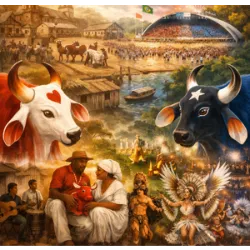
In the interior of Amazonas, this tradition blends with local legends, especially the story of the Auto do Boi (Pai Francisco and Mãe Catirina).
1913 – Emergence of the first Bumba-Meu-Boi groups in Parintins
In 1913, records of the first organized Bumba-Meu-Boi groups in Parintins appear.
During this period, the performances were still simple, held in the streets and at religious festivals.
1930–1940 – Consolidation of the rivalry
The Bumba-Meu-Boi groups begin to gain their own identity in the city.
The two rival groups officially emerge:
Boi Garantido (founded in 1913, according to Oral tradition)
Boi Caprichoso (founded in 1913, also with a strong oral tradition)
The rivalry between red (Garantido) and blue (Caprichoso) intensifies.
1965 – Creation of the Parintins Folklore Festival
In 1965, the Parintins Folklore Festival is officially created.
The objective was to organize and value the competition between the oxen.
The presentations leave the streets and begin to have a more formal structure.
1988 – Construction of the Bumbódromo
In 1988, the Bumbódromo of Parintins is inaugurated.
The space was built especially for the festival, with stands divided for the blue and red fan groups.
This marks the professionalization of the event.
1990–2000 – National expansion and international
The festival gains great visibility in the Brazilian media.
The performances now include:
Giant floats
Complex choreography
Advanced stage technology
2010–present – Cultural heritage and mega-event
The festival has established itself as one of the largest open-air spectacles in the world.
Boi Garantido and Boi Caprichoso continue to compete for the title every year on the last weekend of June.
The event attracts tourists from Brazil and abroad.
In 2018, the festival was recognized as a Cultural Heritage of Brazil by IPHAN.